Most Toronto homeowners searching for basement waterproofing are asking one question: should the fix happen inside the basement or outside the foundation wall? The honest answer is that both methods work, but they solve different problems. Choosing the wrong one wastes money and leaves water coming back next spring.
To pick the right method, it helps to understand what is pushing water into your basement. Three local conditions do most of the damage:
- Clay-heavy soil. Much of the GTA sits on dense clay that drains slowly. After rain or snowmelt, water pools against foundation walls instead of soaking away.
- Hydrostatic pressure. Saturated soil presses water against concrete and block walls. That pressure forces moisture through cracks, tie-rod holes, and the cove joint where the wall meets the floor.
- Freeze-thaw cycles. Ontario winters freeze and thaw the ground dozens of times. Each cycle widens small cracks and loosens old tar coatings on older homes.
Add aging clay weeping tile, poor lot grading and short downspouts, and you get the damp walls, musty smell and puddles that many East York, Scarborough and North York homeowners know well.
How water actually gets into your basement
Before choosing a method, find the entry point. A good contractor will trace the water rather than guess. The most common entry points are:
| Entry point | What you usually see | Typical cause |
| Cove joint (wall-floor seam) | Water spreading across the floor after heavy rain | Hydrostatic pressure under and beside the slab |
| Foundation wall cracks | A wet line or drip running down one spot | Settling, shrinkage or freeze-thaw damage |
| Porous block or poured walls | Damp patches, white chalky efflorescence | Failed or missing exterior membrane |
| Window wells | Water below basement windows | Clogged well drains, poor grading |
| Floor drain or sewer backup | Water rising from the drain | Overloaded municipal sewer, no backwater valve |
| Pipe and tie-rod holes | Small, repeat leaks at the same spot | Unsealed penetrations through the wall |
If water appears in one spot, a targeted crack repair may be enough. If it shows up along several walls, or along the whole floor seam, you are dealing with a drainage problem that calls for a full system.
Interior waterproofing: managing water from the inside
Interior waterproofing does not try to stop water reaching the foundation. Instead, it captures water where it enters and carries it away before it reaches your living space. It is often the most practical choice for finished neighbourhoods where digging outside is hard.
A typical interior system includes:
- Cutting the slab along the inside perimeter of the foundation walls.
- Installing interior weeping tile, a perforated drain pipe laid in clear gravel beside the footing.
- Adding a dimple membrane against the wall so seepage runs down into the drain instead of onto the floor.
- Connecting to a sump pit and sump pump that discharges the water away from the house.
- Re-pouring the concrete and, where needed, fitting a backwater valve to block sewer backup.
Our interior weeping tile installation page walks through this drain system in more detail.
Interior waterproofing works best when:
- Water enters at the cove joint or across several walls
- Your home shares a wall, driveway or tight side yard with a neighbour
- Decks, patios, landscaping or AC units make excavation costly
- You want the work done in any season, including winter
The trade-off is that the foundation wall itself stays wet on the outside. The system manages the water well, but it does not protect the concrete from the soil. Learn more about how we approach interior waterproofing in Toronto.
Exterior waterproofing: stopping water at the source
Exterior waterproofing keeps water from touching the foundation at all. It is the more complete fix, and the approach most engineers prefer when the site allows it.
The process usually looks like this:
- Excavating down to the footing along the affected walls.
- Cleaning and inspecting the wall, then repairing cracks and voids.
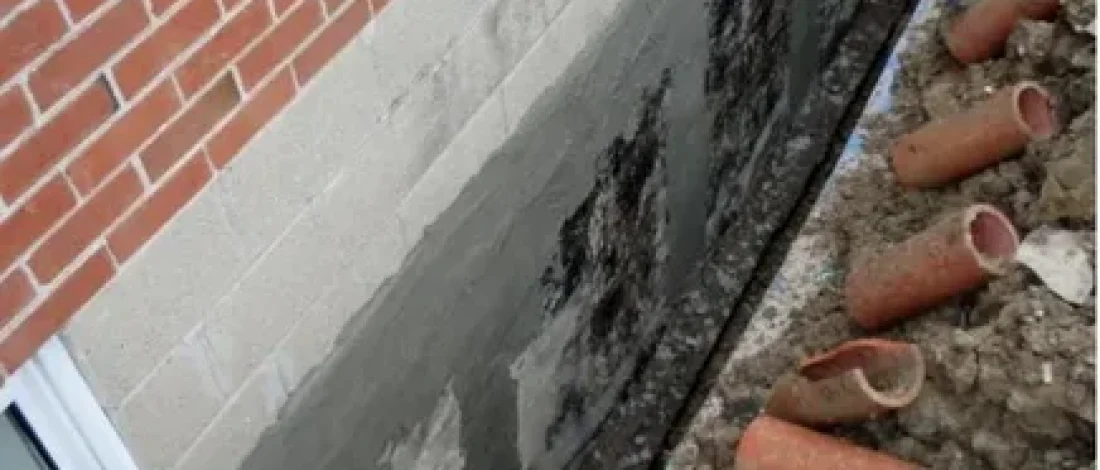
- Applying a rubberized or bituminous membrane to seal the concrete.
- Adding a dimple board to protect the membrane and create a drainage gap.
- Replacing old weeping tile with new perforated pipe in clean gravel.
- Backfilling and regrading so surface water flows away from the house.
Exterior waterproofing works best when:
- Walls are porous, crumbling or showing widespread efflorescence
- The original clay weeping tile has collapsed or is clogged with roots
- You are finishing the basement and want the driest walls possible
- There is room to dig without removing major structures
The downsides are cost, disruption to your yard, and a dependence on weather and access. See our full process for exterior foundation waterproofing.
Interior vs. exterior: side-by-side comparison
| Factor | Interior waterproofing | Exterior waterproofing |
| How it works | Captures and drains water that gets in | Blocks water before it reaches the wall |
| Protects the concrete | No, wall stays wet outside | Yes, membrane seals the wall |
| Disruption | Inside the basement only | Yard, landscaping and walkways |
| Season | Year-round | Best spring to fall, weather dependent |
| Tight lots and shared walls | Well suited | Often difficult or impossible |
| Relative cost | Usually lower | Usually higher |
| Needs a sump pump | Yes | Sometimes |
A quick way to decide:
- Water at the floor seam on several walls, tight lot → interior system
- Crumbling walls, failed clay tile, room to dig → exterior waterproofing
- One leaking crack and dry walls elsewhere → targeted crack repair first
- Severe, recurring flooding → a combination of both, sealed outside and drained inside
Many homes in the GTA end up with a hybrid: exterior work on the worst wall and an interior drain on the rest.
What about crawl spaces?
Crawl spaces follow the same rules, but they bring extra risks. Low, dark and often unvented, they trap humidity that feeds mould, rots floor joists and draws musty air up into the house.
Crawl space waterproofing usually combines a perimeter drain, a sump pump, and a heavy vapour barrier sealed across the floor and up the walls. Some homes also need a dehumidifier to keep relative humidity in check. If your home sits over a crawl space, read more about our crawl space waterproofing service.
Other cases that change the plan:
- Finished basements. Interior work means removing drywall along the perimeter; exterior work leaves finishes untouched.
- Older brick or block foundations. These are more porous, so exterior sealing often pays off.
- Homes with sewer backup history. A backwater valve should be part of any system.
Cost, timing and what a proper assessment includes
No two basements cost the same to waterproof. The price depends on:
- Linear feet of wall that need work
- Excavation depth and access (driveways, porches, neighbours)
- Whether the basement is finished
- Condition of existing weeping tile and drain connections
- Add-ons such as sump pumps, backwater valves and window well drains
Most interior systems take a few days. Exterior jobs can take longer because of digging, weather and backfill.
The most important step is the inspection. A reliable assessment should identify where water enters, check grading and downspouts, look at the condition of the walls, and explain why one method fits better than another. At J.M WaterProofing, every project starts with an on-site assessment and a straight, no-obligation estimate before any work begins.
Frequently asked questions
Is interior or exterior basement waterproofing better? Exterior waterproofing is more complete because it keeps water off the foundation. Interior waterproofing is often more practical and affordable, and it manages water very effectively. The better choice depends on where water enters and how accessible your foundation is.
Can I waterproof my basement in winter? Yes. Interior systems can be installed year-round. Exterior excavation is possible in milder winter weather, but frozen ground can slow the work.
Will sealant paint stop my basement from leaking? Rarely. Waterproofing paint can reduce minor dampness, but it cannot hold back hydrostatic pressure. Active leaks need drainage or an exterior membrane.
Do I need a sump pump with interior waterproofing? In almost all cases, yes. The interior weeping tile collects water, and the sump pump removes it from the house.
How do I know if my weeping tile has failed? Common signs include water at the floor seam, recurring leaks after rain, and a camera inspection showing roots, crushed pipe or silt buildup.
The bottom line
Interior waterproofing manages water that gets in. Exterior waterproofing stops it from reaching the wall. Many Toronto homes need one, and some need both. The right answer comes from finding exactly where and why water enters your basement.
J.M WaterProofing serves Toronto and the GTA, including Burlington, Newmarket, Aurora, Richmond Hill, Ajax and Markham. Our fully insured crews assess every home first and give you a clear price before work starts.
Dealing with a wet basement?Contact J.M WaterProofing for a free, no-obligation estimate, or call (416) 899-9593.