There are two ways to deal with a wet basement. You can let water come through the foundation and manage it once it is inside, or you can stop it from the outside before it touches the concrete. Exterior foundation waterproofing is the second approach, and I think it is the one that actually solves the problem instead of living with it.
It is also the more disruptive one. It means digging a trench around the house down to the footing. That is why homeowners put it off, and why it pays to understand exactly what the work involves before agreeing to it.
I wrote this guide for Burlington homeowners who have seen damp walls, white staining or water on the floor and are comparing options. It covers how water gets in, why this city is exposed, how the exterior method works, how it compares with interior systems, and how to judge a contractor.
How Water Gets Into a Foundation
Water does not need a hole to enter a basement. It needs pressure and time. Three mechanisms account for most wet basements.
-
Hydrostatic pressure
When soil around a house is saturated, the water in it pushes against the wall. Concrete and block are porous, so that pressure drives moisture through the wall itself and through any crack, joint or tie hole.
-
Failed drainage
A perforated pipe called weeping tile runs around the footing to carry groundwater away. Older clay tile cracks, shifts and fills with silt and roots. Once it stops draining, water sits against the wall.
-
Surface water
Soil that has settled and now slopes toward the house, short downspouts and clogged window wells all deliver roof and yard water straight to the foundation.
The signs are easy to read once you know them. A white, chalky deposit on the wall is mineral salt left behind by evaporating water. Damp patches low on the wall after rain point to the footing drain. Water at the joint where wall meets floor usually means pressure from below.
Interior paint-on sealers address none of these. They sit on the dry side of the wall, where the pressure pushes them off.
Why Burlington Homes Are Exposed
Burlington has flooded badly twice in ten years. About 3,000 homes were affected in the 2014 flood and roughly 1,000 in the week of July 15, 2024, according to local reporting on the City’s response.
Geography explains a lot of it. The city sits between the Niagara Escarpment and Lake Ontario, so storm water runs downhill through creeks and neighbourhoods on its way to the lake. Much of the area is built on clay-rich soil, which drains slowly and holds water against foundations long after the rain stops.
Age matters too. Many homes here were built decades ago with clay weeping tile and a thin coat of tar on the foundation. Both have a service life, and in a lot of houses it has run out.
Add freeze-thaw cycles each winter, which widen small cracks a little more every year, and the case for dealing with water properly becomes practical, not theoretical.
How Exterior Waterproofing Is Done
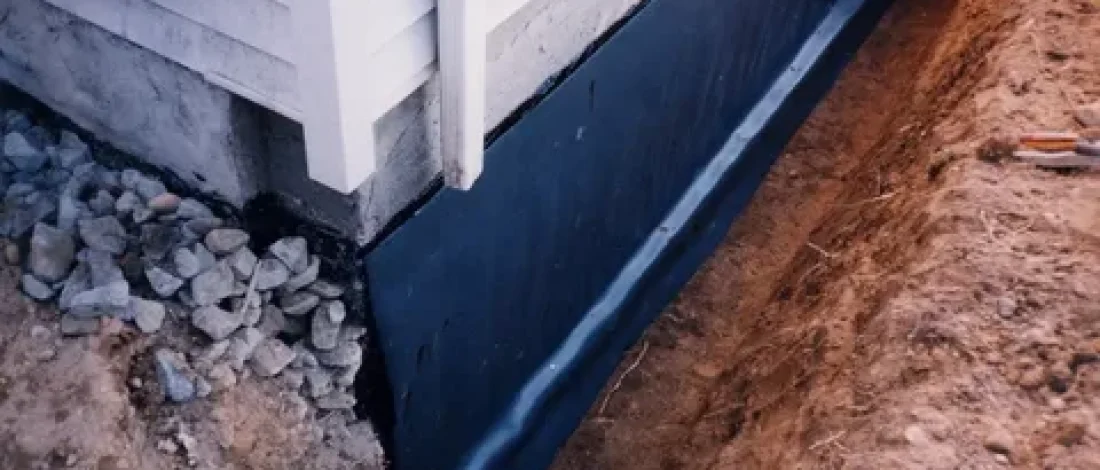
The method is the same in principle on every house: expose the wall, repair it, seal it, and give the water a path away.
-
Locates and protection
Buried gas, hydro and telecom lines are marked. Plants, decks and walkways along the wall are moved or protected.
-
Excavation
A trench is dug along the foundation down to the footing. The sides are sloped or shored so it is safe to work in.
-
Cleaning and inspection
The wall is scraped and washed so every crack, void and old patch is visible.
-
Repairs
Cracks are filled with hydraulic cement or injected, and damaged mortar joints in block walls are rebuilt.
-
Membrane
A rubberized waterproofing membrane is applied to the wall. This is the layer that actually stops water.
-
Drainage board
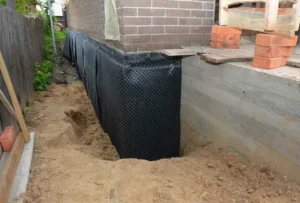
A dimpled plastic sheet goes over the membrane. It protects it during backfill and leaves an air gap so water falls straight down to the drain.
-
New weeping tile
Perforated pipe wrapped in filter cloth is laid beside the footing, bedded in clear gravel, and connected to a sump pump or approved outlet.
-
Backfill and grading
The trench is filled in layers and the surface is graded to slope away from the house.
The detail I would watch most closely is the difference between damp-proofing and waterproofing. A sprayed tar coating resists soil moisture but cracks when the wall moves. A true membrane stretches across small cracks. Ask which one is in the quote.
Exterior vs Interior Waterproofing
Exterior work keeps the wall dry. Interior work keeps the room dry while the wall stays wet. Both have a place, and the right choice depends on access and on what is failing.
| Exterior | Interior | |
| What it does | Stops water before it enters the wall | Collects water after it enters and pumps it out |
| Main parts | Membrane, drainage board, new weeping tile | Interior drain channel, wall liner, sump pump |
| Effect on the foundation | Wall stays dry, which slows deterioration | Wall keeps absorbing water |
| Disruption | Digging outside; landscaping disturbed | Work inside; finished walls and floor edges removed |
| Relative cost | Higher | Lower |
| Best suited to | Accessible walls, failed weeping tile, block foundations | Tight lot lines, attached homes, finished landscaping |
I would choose exterior wherever the wall can be reached. Where a driveway, addition or neighbour is in the way, a contractor may reasonably propose exterior on some walls and interior on others.
Before Anyone Digs
Four checks belong at the start of the job, and all four are cheaper to do first than to fix later.
-
Utility locates
Ontario law requires a locate request through Ontario One Call before excavation. Confirm the contractor has the paperwork.
-
Permits
Waterproofing a wall may not need a building permit, but changes to drainage connections, sump discharge or structure can. Ask the City of Burlington’s building department before work starts.
-
Subsidies
Halton Region has offered basement flooding subsidies. As reported in August 2024, these included 100% of weeping tile disconnection and sump pump installation up to $5,000, 100% of downspout disconnection up to $500, and 50% of a backwater valve up to $675. Programs change, so confirm current terms with the Region before you sign.
-
Simple fixes
Extend downspouts, clean eavestroughs and regrade soil first. Sometimes that is enough, and no honest contractor will mind you trying.
How to Choose a Contractor
Everything that matters on this job gets buried, so the contract and the photo record are your only evidence of what was done.
- Will you dig to the footing along the full length of the affected wall?
- Which membrane product will you use, and is it waterproofing or damp-proofing?
- Are you replacing the weeping tile, and where will it drain?
- Will you photograph the wall after cleaning, after the membrane and before backfill?
- Is the warranty written, how long does it run, and does it transfer to a new owner?
- Can you show proof of liability insurance and WSIB coverage?
- Who handles locates, permits and subsidy paperwork?
A transferable warranty is the item I would press hardest on. Foundation work is often done shortly before a sale, and a warranty that ends with the current owner is worth far less.
JM Waterproofing offers exterior foundation waterproofing in Burlington, and its service page is a reasonable place to begin. Put these questions to them as you would to any contractor, and ask for an itemized quote that names the products.
The Bottom Line
Exterior waterproofing is expensive and messy because it fixes the cause. It puts a continuous membrane on the wet side of the wall and gives groundwater a working drain. In a city that has flooded twice in a decade, on soil that holds water, that is the durable answer wherever the wall can be reached.
FAQs
1. How Do I Know I Need Exterior Waterproofing?
Recurring damp patches low on the walls after rain, white mineral staining, and water at the wall-floor joint all point to water pressure outside. If fixing downspouts and grading does not stop it, the wall or the weeping tile needs attention.
2. Is Exterior Waterproofing Better Than Interior?
For the foundation, yes. Exterior work keeps the wall dry, while interior systems only manage water that has already come through. Interior is the practical choice where the outside wall cannot be reached.
3. How Long Does the Work Take?
It depends on how many walls are involved, the depth of the footing, access for equipment and the weather. I have no reliable single figure. Ask for a written schedule per wall.
4. Can It Be Done in Winter?
Frozen ground makes digging harder and some membranes have minimum application temperatures, so most work is done from spring to fall. Ask the contractor what their product allows.
5. Are There Subsidies for Burlington Homeowners?
Halton Region has offered subsidies for sump pumps, weeping tile disconnection, downspout disconnection and backwater valves. Amounts and eligibility change, so check the current program before committing.