You head downstairs after a heavy rain and notice a dark streak running down the basement wall. Maybe there is a small puddle on the floor, a musty smell, or a crack you have walked past for years that suddenly looks wider. For many Burlington homeowners, that is the moment a foundation crack goes from “something to watch” to “something to fix now.”
The next question is almost always the same: should you inject the crack from the inside, or dig down and repair it from the outside? Both methods work, but they solve different problems and come with very different costs and disruption.
In this guide, J.M WaterProofing explains how foundation cracks form, how crack injection and exterior excavation compare, and how to decide which approach is right for your Burlington home.
Why Foundations Crack in Burlington Homes
Almost every poured concrete foundation develops some cracking over time. Common causes include:
-
Concrete shrinkage
As concrete cures, it shrinks slightly. Thin vertical or diagonal cracks often appear within the first few years of a home’s life.
-
Settlement
Soil beneath the footings compresses and shifts, especially in newer subdivisions or on backfilled lots.
-
Hydrostatic pressure
After heavy rain or spring melt, saturated soil presses against basement walls and forces water into any weak point.
-
Freeze-thaw cycles
Burlington’s winters freeze moisture in the soil and in existing cracks. Expansion widens cracks a little more each season.
-
Clay-rich soils
Parts of Halton Region have soils that swell when wet and shrink when dry, putting seasonal stress on foundation walls.
-
Poor drainage
Short downspouts, negative grading and clogged weeping tile send more water toward the foundation than it was designed to handle.
Older neighborhoods such as Aldershot, Brant Hills, and parts of downtown Burlington may also have block or rubble foundations, which leak differently from poured concrete and often need different solutions.
Is Your Foundation Crack Serious?
Not every crack needs immediate repair, but some definitely do. Here is a simple way to assess what you are seeing.
Usually minor, but monitor:
- Hairline vertical cracks that are dry
- Cracks that have not changed over time
Repair soon:
- Any crack that leaks or shows damp edges after rain
- White mineral deposits (efflorescence) along the crack
- Cracks in finished basements, where hidden leaks can damage drywall and flooring
Get a professional assessment:
- Horizontal cracks or stair-step cracks in block walls
- Cracks wider than about 6 mm, or wider at one end than the other
- Walls that bow, lean or bulge inward
- Doors and windows upstairs that suddenly stick
Horizontal cracks and bowing walls can indicate structural pressure that needs more than waterproofing. Have them evaluated before choosing a repair method.
Method 1: Interior Crack Injection
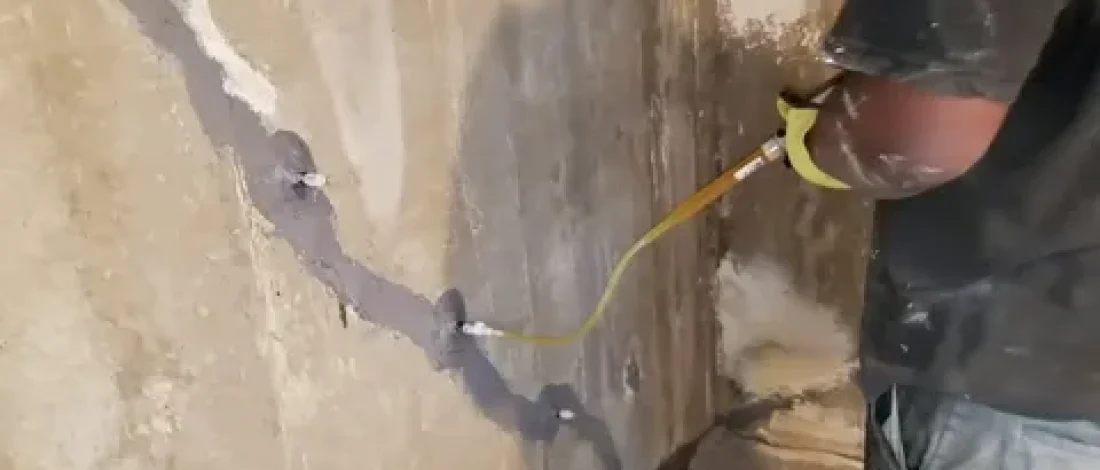
Crack injection seals a foundation crack from inside the basement without excavation. It is the most common repair for leaking vertical and diagonal cracks in poured concrete walls.
How crack injection works
- The crack surface is cleaned, and injection ports are installed along its length.
- The surface of the crack is sealed with a paste so the injected material stays inside.
- A liquid resin is pumped into the crack through the ports, starting at the bottom and working up, until it fills the crack through the full thickness of the wall.
- Once cured, the ports are removed and the surface is finished.
Polyurethane vs. epoxy injection
- Polyurethane expands as it cures and stays flexible. It reacts with water, making it ideal for actively leaking cracks. It is the most common choice for waterproofing.
- Epoxy cures hard and bonds the concrete back together. It is used when structural bonding is the priority and the crack is dry.
Pros of crack injection
- No excavation, so no damage to landscaping, driveways or decks
- Usually completed in a few hours
- Lower cost than digging
- Works well year-round, including winter, since it is done from inside
Limitations of crack injection
- Only works on poured concrete walls, not block or stone foundations
- Requires access to the crack, so finished walls must be opened
- Does not address exterior problems such as failed waterproofing or clogged weeping tile
- Not ideal for cracks with significant ongoing movement
Method 2: Exterior Excavation and Waterproofing
Exterior repair means digging down along the outside of the foundation to expose the wall at the crack, then sealing and waterproofing it from the outside, where water actually enters.
How exterior crack repair works
- The area outside the crack is excavated down to the footing.
- The wall is cleaned and inspected, and the crack is sealed with hydraulic cement or a sealant.
- A waterproofing membrane is applied over the repaired area, often with a dimple drainage board for added protection.
- The weeping tile at the footing is inspected and cleared, repaired or replaced if needed.
- The trench is backfilled with clean material and graded away from the house.
J.M WaterProofing provides full for homeowners who need a complete exterior solution.
Pros of exterior repair
- Stops water at the source, on the outside of the wall
- Works on poured concrete, block and older foundations
- Lets the crew inspect and fix weeping tile and drainage at the same time
- Ideal when there are several cracks or the original waterproofing has failed
- No need to disturb finished basement walls
Limitations of exterior repair
- Higher cost than injection
- Disrupts landscaping, walkways or patios around the excavated area
- Takes longer, often a day or more for a single crack
- More difficult in frozen ground and in tight spaces beside driveways, porches or neighbouring homes
Injection vs. Digging: Quick Comparison
| Factor | Interior crack injection | Exterior excavation |
| Best for | Single leaking cracks in poured concrete | Multiple cracks, block walls, failed membranes |
| Disruption | Minimal, done inside | Excavation outside the home |
| Time | A few hours | One day or more |
| Relative cost | Lower | Higher |
| Fixes drainage issues | No | Yes, weeping tile can be addressed |
| Winter-friendly | Yes | Limited by frozen ground |
How to Decide Which Method Is Right for You
Choose crack injection if:
- You have a poured concrete foundation
- There are one or two leaking cracks
- The rest of the wall is dry
- The area outside is hard to dig, such as under a driveway or deck
Choose exterior excavation if:
- You have a block, stone or rubble foundation
- Water comes through several areas or at the floor-wall joint
- Your weeping tile is old, clogged or collapsed
- The basement is finished and you do not want to open walls
- Injection has been tried and the crack still leaks
In some homes, the best long-term solution combines methods, or adds with drainage and a sump pump where exterior access is limited.
Don’t Forget Drainage
No crack repair lasts if water keeps flooding the soil against your foundation. Alongside any repair, check that:
- Downspouts discharge at least 1.5 to 2 metres from the house
- The ground slopes away from the foundation
- Window wells are clean and drain properly
- Your sump pump, if you have one, is working and has a backup
FAQs
How long does foundation crack injection last?
A properly installed polyurethane injection fills the crack through the full wall thickness and can provide a long-lasting seal. Results depend on correct installation and stable conditions.
Can foundation cracks be repaired in winter?
Yes. Interior crack injection can be done year-round. Exterior excavation is possible in winter but can be limited by frozen ground and weather.
Does home insurance cover a foundation crack?
Most policies do not cover cracks caused by settlement or gradual seepage. Some sudden water damage may be covered. Check your policy details.
Can I fix a foundation crack myself?
DIY kits exist, but proper injection requires full-depth filling and correct pressure. A failed DIY repair can make professional repair harder.
How do I know if my crack is structural?
Horizontal cracks, stair-step cracks, bowing walls and cracks wider at one end are signs that a professional should assess the structure.
Get Your Burlington Foundation Crack Fixed Right
Every foundation leaks a little differently. That is why J.M WaterProofing assesses your foundation, soil and drainage before recommending a fix, so you pay for the repair your home actually needs. Whether the answer is a quick interior injection or full exterior waterproofing, our trained crews use quality materials and leave your property clean.
Call J.M WaterProofing at (416) 899-9593 or email Jmwaterproofingleaks@gmail.com to book your free, no-obligation estimate in Burlington and across the GTA.